
Identify the replacement before sending anything
A remake should tell the kitchen exactly which pizza needs replacing, why, and what should remain unchanged. Reprinting an entire three-pizza order can create confusion if staff cannot distinguish reference information from a new production instruction. Give one employee ownership of the replacement and use your approved remake process. Keep the connection to the original sale without pretending the kitchen action automatically determines the payment or accounting treatment.
Confirm the affected size, crust, toppings, and any special instructions with the guest or responsible employee. Check whether the original pizza is still at the pass, already boxed, or with the customer. Decide who gives the revised pickup estimate. A clear replacement instruction is more useful than a hurried note saying wrong pizza when several tickets look similar and more than one person is trying to help.
Separate production from money
A replacement may be provided without collecting another payment, but the transaction treatment still needs the manager’s approved policy. A remake, a canceled item, and a refund are separate actions. Do not ring a second paid sale merely to obtain a kitchen ticket unless that is the authorized supported process. If a system uses a specific adjustment or reason code, ask what it does to reports before adopting it.
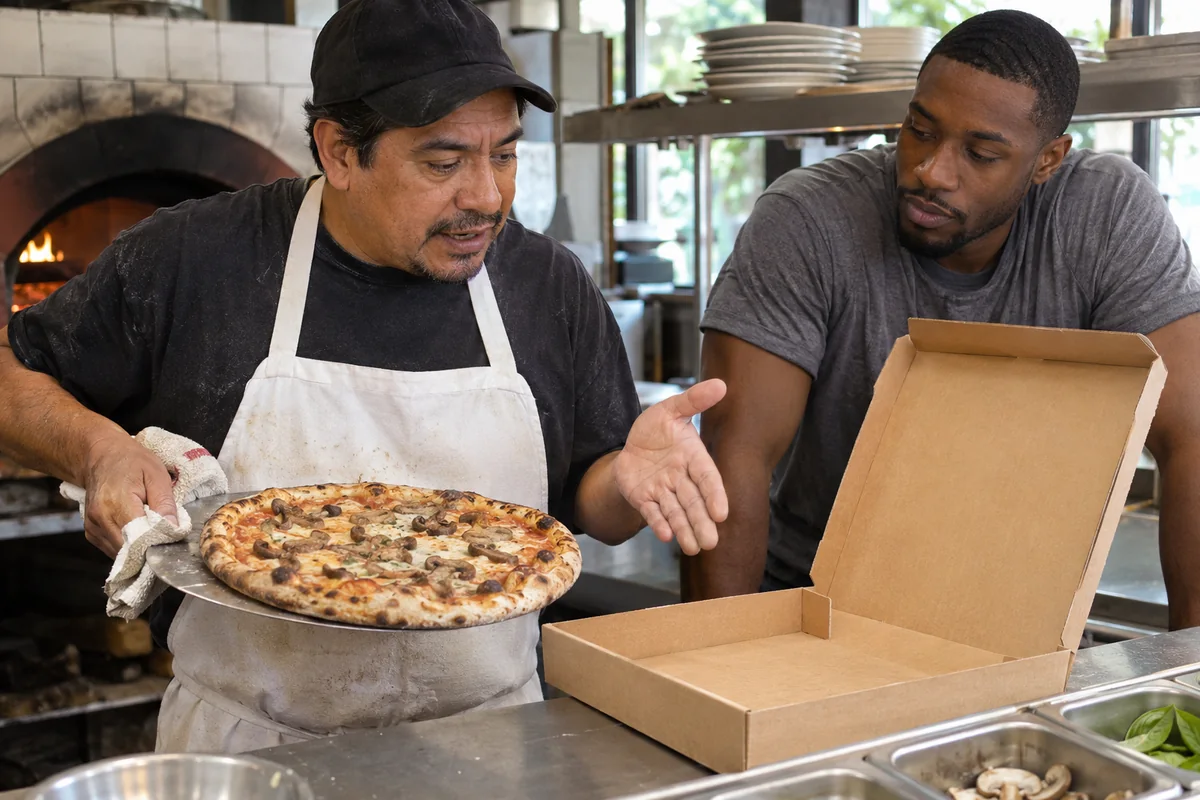
The correction guide explains financial distinctions. Here the focus is production control: getting only the replacement pizza made correctly. An illustrative guest order contains two regular pizzas and one mushroom pizza on the wrong crust. The team confirms the intended crust, identifies the mushroom pizza as the sole replacement, and leaves the other completed pizzas outside the new production instruction.
Use a remake handoff card
Record the original order reference, affected item, corrected build, reason, approver, production owner, and revised handoff plan. Keep the record within your approved system or operating method rather than creating uncontrolled customer-data copies. The kitchen lead acknowledges the replacement before the cashier gives an estimate. If the kitchen cannot read the distinction clearly, stop and confirm directly instead of sending several versions until one appears to work.
Before boxing, compare the replacement against the corrected instruction. Mark or stage it according to the shop’s approved handoff routine so it does not leave with another order. The pickup guide offers related staging principles. If other pizzas are waiting, follow your trained food-quality and safety procedures; a remake instruction does not decide whether previously prepared food remains suitable to serve.
Learn from remakes without misreading the count
Review reasons such as incorrect entry, preparation error, quality rejection, and customer-requested change separately. Do not infer employee misconduct from a remake total alone. Pizza Today’s quality-control discussion treats correcting a wrong pizza as a service issue; your own review should establish what actually happened and what the team can improve. Keep any proposed performance target grounded in your business records, not an invented industry benchmark.
Rehearse a single-item remake within a multi-pizza order, a change after boxing, and a replacement followed by an approved refund. Inspect kitchen output and the final record together. Use the Freedom POS contact page to confirm current pizza workflows and reason-code behavior with those scenarios. Ask the team to demonstrate what prints, what changes financially, and which manual confirmations remain necessary before relying on a generic reprint function.